
History of All Saints Church
Open to the public 10am-4pm daily

All Saints North Street stands on a site that has been hallowed for worship for over 1000 years, with significant elements surviving from the 14th and 15th centuries.
If you come into All Saints today, you see a fairly narrow central ‘Nave’ (the part of a church where the congregation sit) with a ‘Chancel’ (where the main or ‘High’ Altar is) which is the same length and width as the Nave and on the far side of an ornate carved wooden Screen. Both Nave and Chancel have Aisles on both left and right, effectively making the church three times as wide as the Nave. Pillars and arches on left and right separate the Aisles from the Nave and Chancel. There is no clerestory (windows above the archways) – Nave, Chancel and Aisles are all of about the same height.
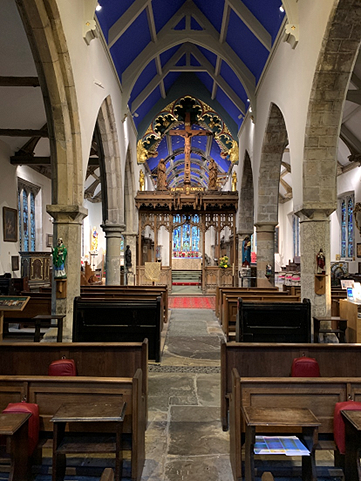
Because of the absence of a clerestory there are no windows at all in the Nave and Chancel except one at each extreme end. But the Aisles are full of large windows admitting plenty of light to the church, and most of them are filled with a dazzling array – one of the best in the whole country – of 14th and 15th century stained glass.
So how old is this building? Much of what you can see dates from the 12th to the 14th century, though you can’t always tell by looking. But as always in ancient churches this bald statement conceals a host of details.
The building started as a small rectangular Anglo-Saxon church – that is to say, one built before the Norman Conquest of 1066. We don’t know how long before. It is situated in what was the Roman civilian city of Eboracum, just beside the Roman road that crossed the river to the military fortress on the other side where York Minster now is. The Romans were here from AD 71 to 410, and the city has been continuously lived in ever since. At some point in the confused centuries (the ‘Dark Ages’) between 410 and 1066 a Christian community built the first All Saints. The dedication to ‘All Saints’ is typical of pre-1066 church foundations.
This Anglo-Saxon church was on the same site that the present church occupies.It consisted of a Nave and a small rectangular or semicircular Chancel. Nave and Chancel met where they still do, at the Screen. The Nave was the same width as the existing Nave but only half as long, reaching back to a point about half way towards the present back of church.
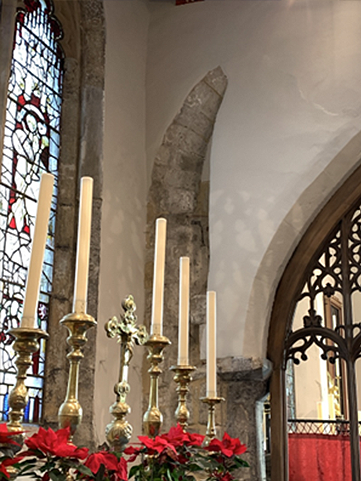
The Norman Conquest of 1066 brought political stability and increased trading wealth, and the church was found to be too small. A programme of rebuilding and extending began. As always in the medieval period the work began with the Chancel, seen as the most important part of the building because it houses the High Altar. In a two-stage process that was completed by 1150, the Chancel was extended to its present length. There were still no side Aisles, and the walls on left and right would have had fairly small round-headed windows of typical Norman pattern. The remains of one side of one of these windows can still be seen in the right-hand wall just beside the High Altar.
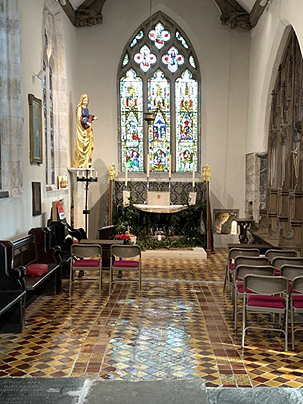
The Chancel had now reached (and still does) much closer to the river, and possibly for that reason flooding became an increased risk. In 1180 the Chancel floor was raised about 1 metre (3ft) to its present level, and then work could proceed to the Nave. By about 1200 the Nave had been extended back as far as the present entrance door, and its side walls had been pierced with arches giving into newly-built Nave Aisles. The left-hand (north) Aisle came first, with the south Aisle following 10 years later. This time gap explains why the pillars and arches into the Nave Aisles are in different styles on left and right.
More aisle-building followed in 1200-1210: the left-hand (north) wall of the Chancel acquired an Aisle to house a new ‘Lady Chapel’, meaning one dedicated to St Mary, ‘our Lady’. This again required piercing the Chancel’s north wall with archways giving access into the Lady Chapel.
Just over 100 years later the same process led to the building of the right-hand (south) Chancel Aisle. This long time lapse explains the very great difference between the Chancel pillars and arches on left and right. The pillars are not in pairs but are in effect staggered.
Both north and south Chancel Aisle side walls are leaning outwards – it seems the ground may have been more unstable than the builders realised. This can be seen quite clearly on the south side, where the window at the end is noticeably leaning to the right. The lean is evident in the Lady Chapel too (the north side), where a hanging lamp is suspended on a chain. The chain is necessarily vertical like anything hanging down, but it appears to be slanted to the left. And the modern statue of our Lady stands on a pillar that is precisely vertical but looks far from it!
Perhaps because of this lean, the outside wall of the south Chancel Aisle had become dangerous by the 1860s and had to be completely rebuilt. They took the opportunity then to widen this Aisle to be the same width as the Nave Aisle.
The final extension came in the early 1390s. The Nave was extended back westwards to its present length, and at the new west end a tall slender tower and spire were added, then as now the highest in York apart from the Minster.
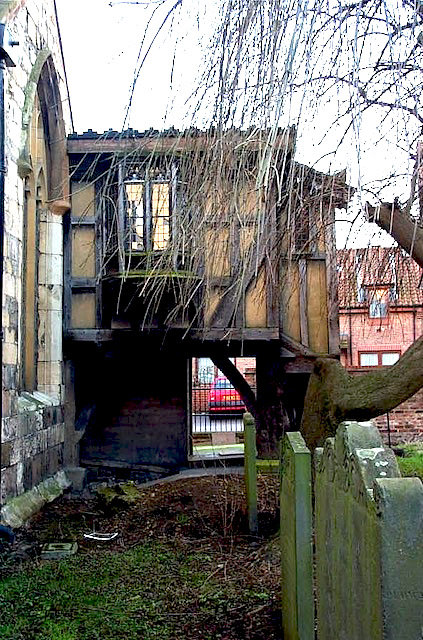
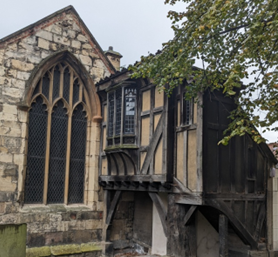
On the outside of the new west wall a newly-built ‘Anchorhold’ housed an ‘anchoress’ or solitary religious woman, one of many such Anchorholds in York’s parish churches at the time. All these anchorholds were destroyed at the Reformation; uniquely the All Saints anchorhold was rebuilt in the early 20th century and still stands.
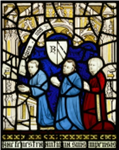
All Saints as a building was now complete as you see it today. The glorious stained-glass windows were mostly still to come. The stained glass in the east (far-end) windows of the two Chancel Aisles had been installed between 1330 and 1340. But the bulk of the glass dates from the time of Fr James Baguley, who was Rector of All Saints from 1413 till he died in 1440 and was probably the driving force behind the creation of the windows. He is pictured kneeling at the foot of the St Michael window (in the south Aisle) as one of the donors of that window – he is the person on the left.

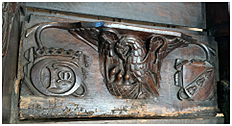
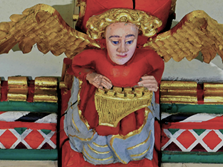
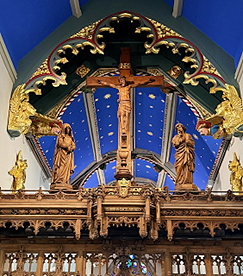
A later Rector from 1469 to 1475, Fr John Gillyott, had the splendid ‘angel’ hammerbeam ceilings installed over the Chancel and both Chancel Aisles. His also was the Rector’s stall (on the right-hand side of the Chancel), which has a misericord carved with his initials and coat of arms and his favourite device of the ‘pious pelican’ feeding her chicks on her own blood, as the legend had it, symbolising Christ feeding his flock with his blood in the Mass.
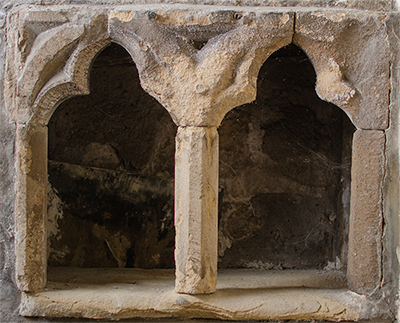
A very rare survival in the Chancel is a small two-arched recess to the left of the High Altar. This is an ‘Easter Sepulchre’, a common fitting in medieval churches. During worship on Good Friday, the day marking the crucifixion of Jesus, a cross was held up for the people to venerate. (It still is.) In the Middle Ages this cross was taken at the end of the service to the Easter Sepulchre and ‘buried’ behind curtains. It was joyously retrieved on Easter Morning, a vivid symbol of the resurrection of Jesus.
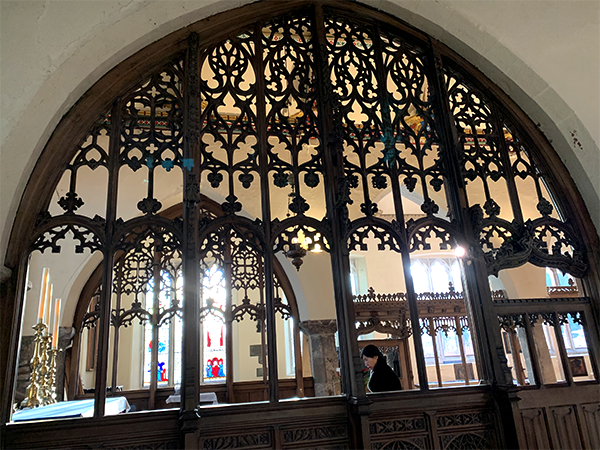
Other fittings are much newer. The Chancel Screen, and the other very fine carved wooden screens across the Chancel Aisle archways, date from the years just before and after the First World War, though similar screens would certainly have been present originally
The Anchorhold had been destroyed at the Reformation in the 16th century, and the present replica was built at the beginning of the 20th century.
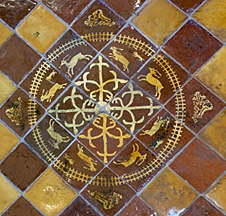
A superb tile pavement in the medieval style was installed in the Lady Chapel in 2012.
The 1470 angels on the Chancel ceiling were painted in vibrant colours in the 1970s, echoing the original colouring traces of which could still be discerned.
More recently, in 2024 the Chancel ceiling itself was coloured blue and spectacularly covered with gold stars – a fitting climax to a glorious buildling.
For further information, see our splendid Guide Book