Our Liturgical Heritage
Open to the public 10am-4pm daily

The Church of England inherited her Mass liturgy from the liturgy of the Latin west, already a thousand years old by the time of the first English Books of Common Prayer in the mid-16th century.
The revision of the liturgy by Thomas Cranmer, archbishop of Canterbury under Henry VIII and Edward VI, translated and modified the Latin Mass. Its language, of great beauty and power, was a strong influence on the development of early modern English which went on to produce Shakespeare and the King James Bible.
However, the content of Cranmer’s Mass grew to seem increasingly problematic over the ensuing years and centuries. His knowledge of the liturgy of the Early Church was much less good than he thought it was, and he was heavily influenced by particular debates and disagreements of his day that can now seem marginal and idiosyncratic. In addition, he envisaged the Church as operating in a pastoral environment of settled rural communities.
By the second half of the 19th century, industrialisation and urbanisation had enormously changed society. Anglican priests of the anglo-catholic tradition ministering (often heroically) in slum parishes felt the strong need for liturgy that gave scope for increased colour and ceremonial in the Mass along with a much wider variety of feast days to celebrate than Cranmer’s very stripped-down set.
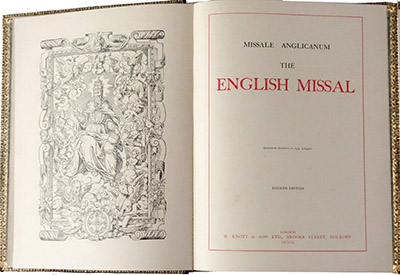
A group of these priests found an answer in adopting the Roman Missal, virtually unchanged for well over a millennium. They had no quibble with its by-and-large age-old theology, but only with its language – it was of course still in Latin (and remained so until the 1960s), and Rome’s insistence on Latin in the liturgy had been one of anglicanism’s chief complaints at the Reformation. They set about translating the Missal into English, using Cranmer’s translations wherever available and aiming to replicate Cranmer’s style elsewhere.
The result was The English Missal, which they viewed as authentically and loyally anglican, a natural development of the process Cranmer had started.
The English Missal was popular in anglo-catholic parishes, including All Saints, throughout the first half of the 20th century. It fell out of use in many in the wave of liturgical revision which swept the churches in the 1960s. The watchword became ‘vernacular’ liturgy, rewritten in a contemporary idiom. Rome abandoned Latin and drastically rewrote the Mass. The Church of England sidelined Cranmer and produced a series of revised liturgies using ‘you’ not ‘thee/thou’. Only a minority of churches, again including All Saints, swam against this tide and adhered to the traditional Mass.
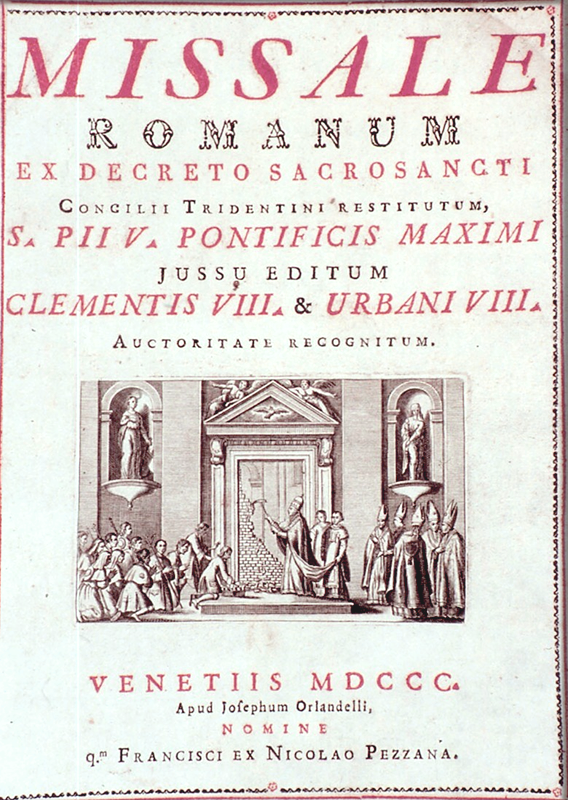
By the end of the 20th century the tide had turned. There was a growing feeling in all the churches that perhaps the baby had been thrown out with the bath-water. Rome re-wrote the Mass again (along more traditional lines), the Church of England produced ‘Common Worship’ with the avowed aim of recovering some of the richness and resonance of earlier liturgy – and The English Missal was once again in print.
This, in brief, is how All Saints got its current English Missal liturgy. Once swimming against the tide, now swimming with it, it offers a Mass liturgy of great spiritual power, with vigorous congregational participation, long periods of prayerful silence, and plenty of colour, light and joy, much valued by those who attend and who in many cases are willing to travel large distances to share in it. At the same time it is firmly of the Church of England, with its liturgy falling squarely within the permitted variations of ‘Common Worship’s’ standard shape, and with the Church of England’s understanding of itself as being in full continuity with the church of St Augustine of Canterbury and St Paulinus of York in the first millennium.
We urge you to experience for yourself this very rich heritage.