

The York Gradual
Open to the public 10am-4pm daily
- Pathbreaking new edition of this Manuscript of around 1420 in the Bodleian Library, Oxford
- Published by All Saints North Street
- Edited, transcribed and translated by Fr Andrew Horsman
- Printed in three parts, £25 each or £60 for the complete set of three.
What do we know
about this manuscript of the York Gradual?
- It was very large – much bigger than A4 size, far too big and heavy to hold, so permanently sited on a lectern (see picture 1)
- It contains all the plainchant music sung at Mass in northern England (picture 2)
- It remains hugely important: our only witness to what worship sounded like in ordinary parish churches.
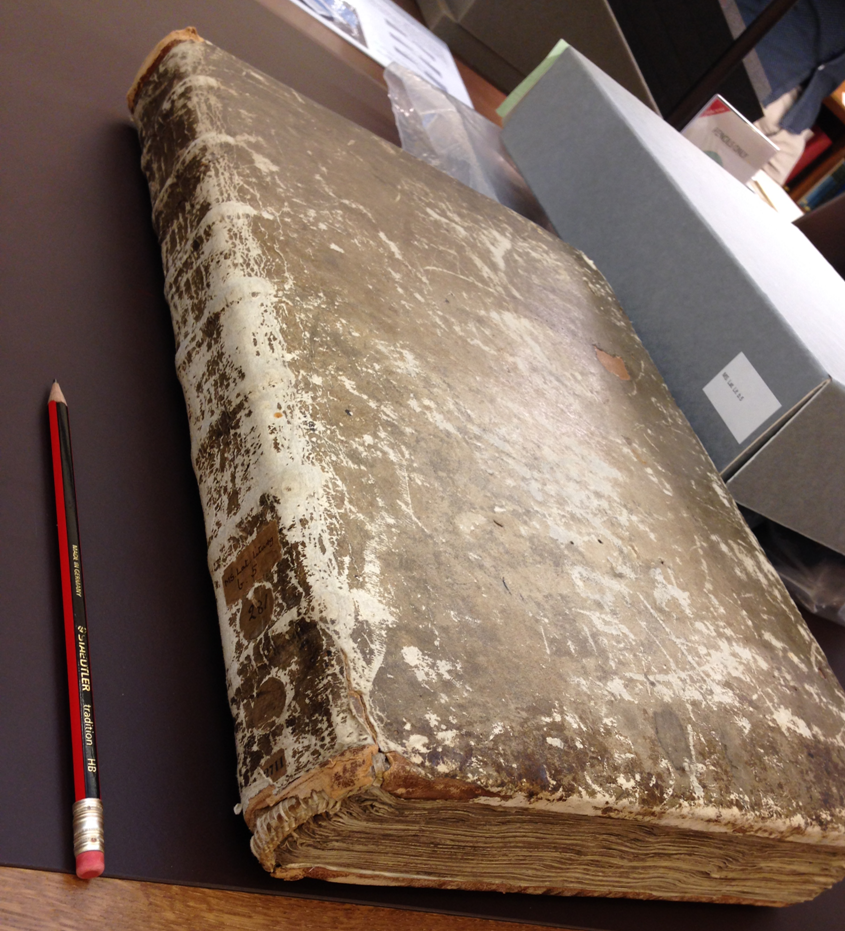
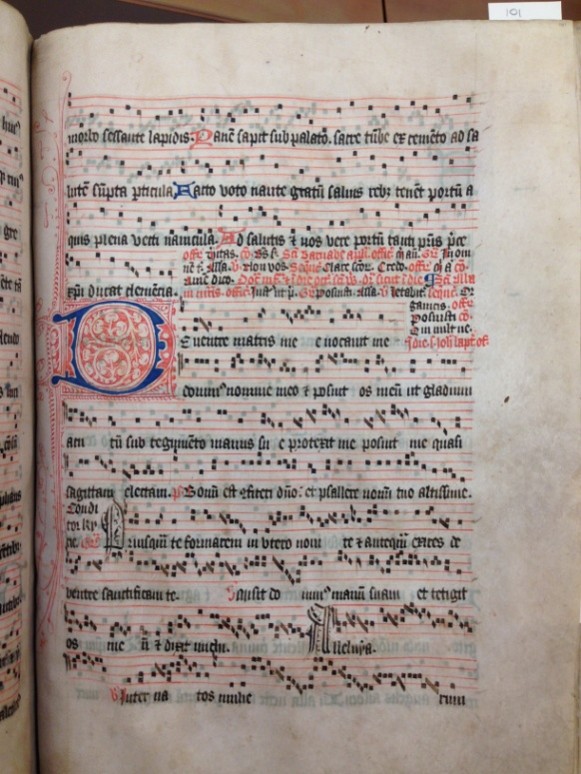
Why is it the only witness?
- Was it made for a big church in an important place? No – for insignificant St Peter’s, East Drayton, Notts (picture 3)
- Were only a few such books ever made? No – since 1250 every church had had to possess one
- What happened to all the others? After Henry VIII died in 1547 the government of England passed to protestant regents acting for the boy-king Edward VI. They introduced revised church services in English in 1549, then in 1550 ordered the wholesale destruction of all previously-used service books
- This was book-burning on a horrifying scale, far greater than in Nazi Germany. Hundreds of thousands of books, mostly beautiful hand-produced manuscripts on parchment, were destroyed, in a deliberate attempt to erase an entire liturgical culture.
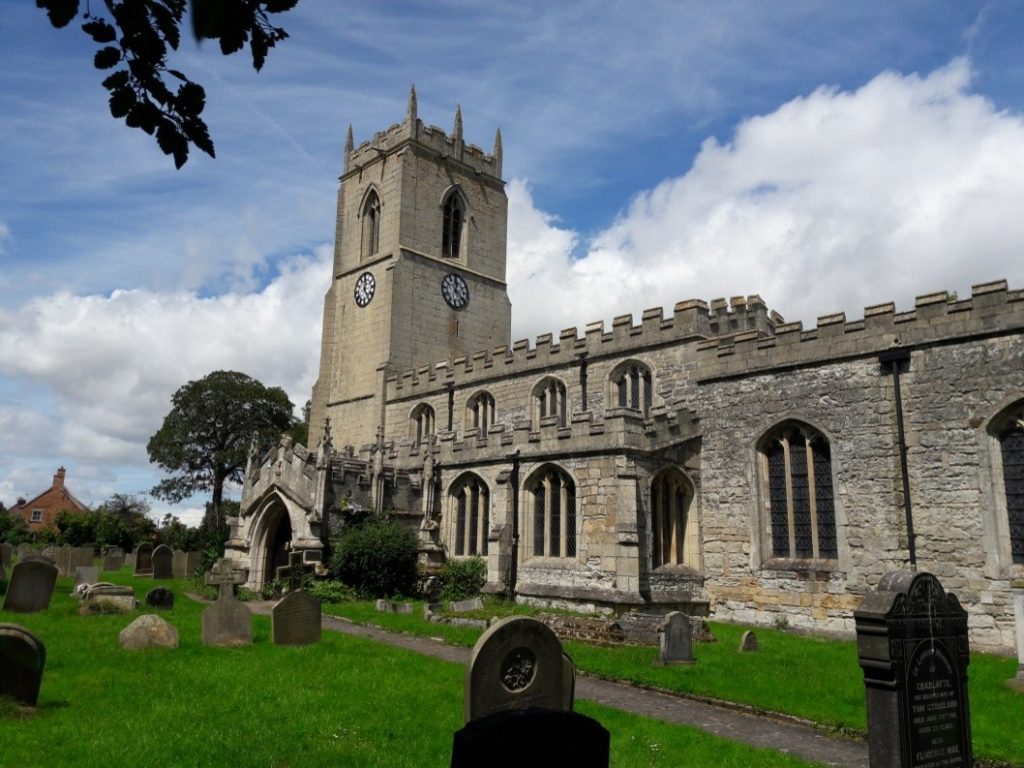
What happened to this manuscript after 1550?
- Presumably hidden (at great personal risk)
- Lost to sight until it surfaced in a private collection in Nottinghamshire in the 18th century
- Eventually bought by the Bodleian Library in 1901 and given the shelf mark Lat. Liturg. b.5
- Black-and-white facsimile edition issued in 1998
- Now for the first time published in a full scholarly edition and translation.
What is the music in the York Gradual manuscript?
- Six chants sung at specified points during Mass, with words nearly all chosen from the Psalms:
- Introit chant at the start of Mass
- Three chants before the Gospel reading:
- the Gradual
- the Alleluia
- the Sequence, a long hymn-like piece with non-biblical words
- In Lent the Alleluia and Sequence are replaced by the Tract, a few verses from a Psalm
- The Offertory chant as the altar is prepared for the Sacrament
- The Communion chant as Holy Communion is administered.
- A separate set of these six chants for each Sunday, each holy day and each saint’s day throughout the year
- Multiple sets of these six chants for Masses in honour of the Blessed Virgin Mary, varying according to the season
- The fixed texts sung at every Mass: Kyrie, Gloria in Excelsis, Credo, Sanctus, Benedictus and Agnus Dei, with music varying according to the season and feast-day, and with many chants having added texts (‘tropes’) for specific occasions.
How much of this music is specific to the Use of York?
- Many of these chants are the same as, or similar to, those used in southern England (the ‘Use of Sarum’).
- But quite a few are unique to the Use of York, and The York Gradual is our only source for their music.
How to read the manuscript
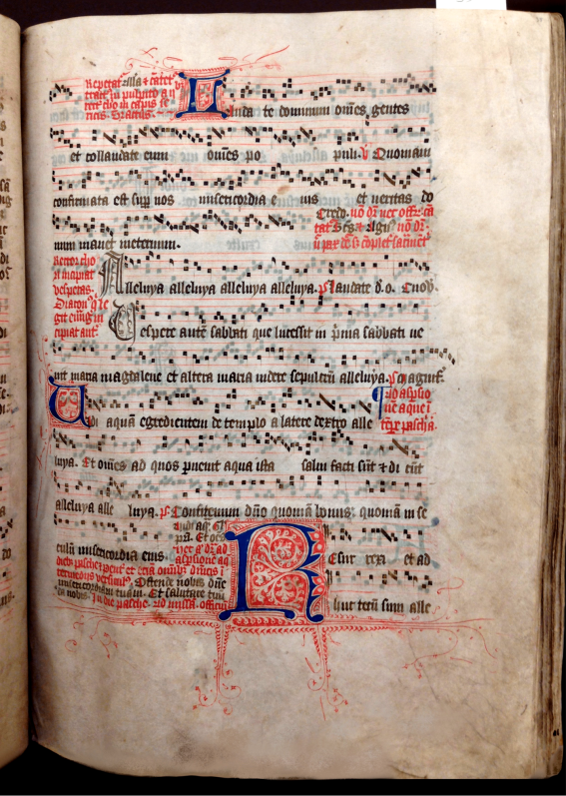
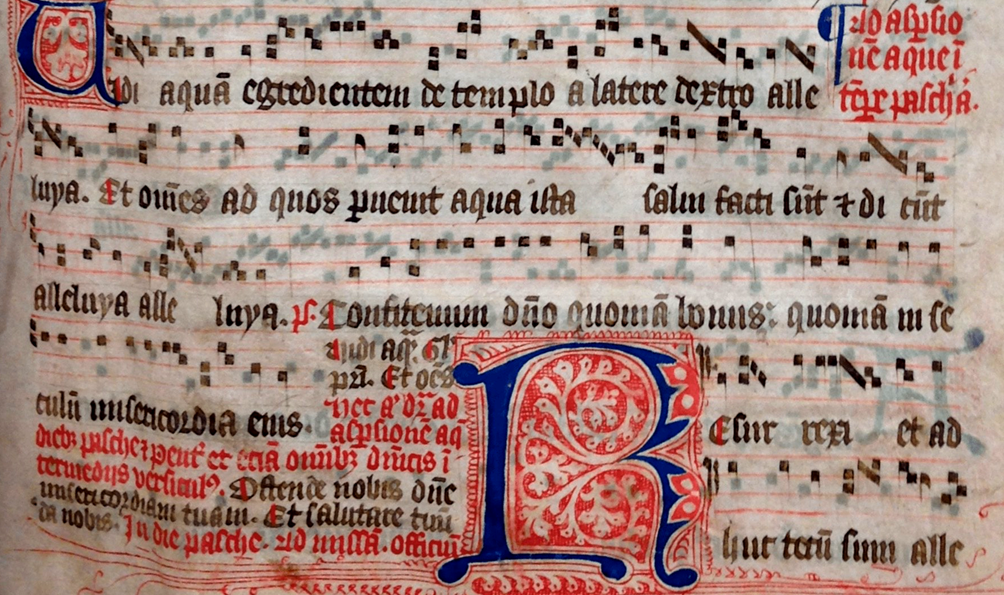
This page of the manuscript in Picture 4 has the start of the liturgy for Easter Day. The large capital R at the foot of the page is the first letter of Resurrexi (I am risen), the start of the Introit for Easter Day.
Just before this capital R comes the chant for Vidi aquam, sung in Eastertide instead of Asperges as the congregation are sprinkled with holy water. Picture 5 shows this detail enlarged.
What does it say?
- The first line of chant can be read fairly easily – Vidi aquam egredientem de templo a latere dextro alleluya (‘I beheld water issuing forth from the Temple on the right-hand side, alleluya’).
- The heading is at the far top right in red (‘rubric’) and is full of abbreviations. It reads:
- Ad aspersionem aque in tempore paschali Antiphona (‘Antiphon at the sprinkling of water in Eastertide’)
- Decoding this word by word:
- The word aspersionem does not fit on the line and part of it is on the next line – but they never used hyphens.
- The letter s is always (except at the end of a word) written as a ‘long s’, looking like a lower-case f but without the cross-bar.
- The syllable –per- is written as p with a curly underscore. The final syllable -nem is written ne with a horizontal line or ‘macron’ above the e, indicating the omission of m.
- Similarly the word in is written simply at i with macron above.
- Tempore appears as te macron above, p with curly underscore for por, e.
- Paschali is Pasch and a superscript i.
- Antiphona is simply a.
All users of the Gradual would have been very familiar with these and similar abbreviations.
Why did they abbreviate so heavily?
- Parchment and ink were very expensive
- Shortening words saved a lot
- If unabbreviated, the manuscript would be much, perhaps over 50% , longer. The resulting book would go from very large and costly to impossibly unwieldy and ruinously expensive.
What does this page look like as now transcribed?
Picture 6 shows how this page of the manuscript appears in the now newly published transcription. Throughout the transcription the Latin originals and their English translations are on facing pages.
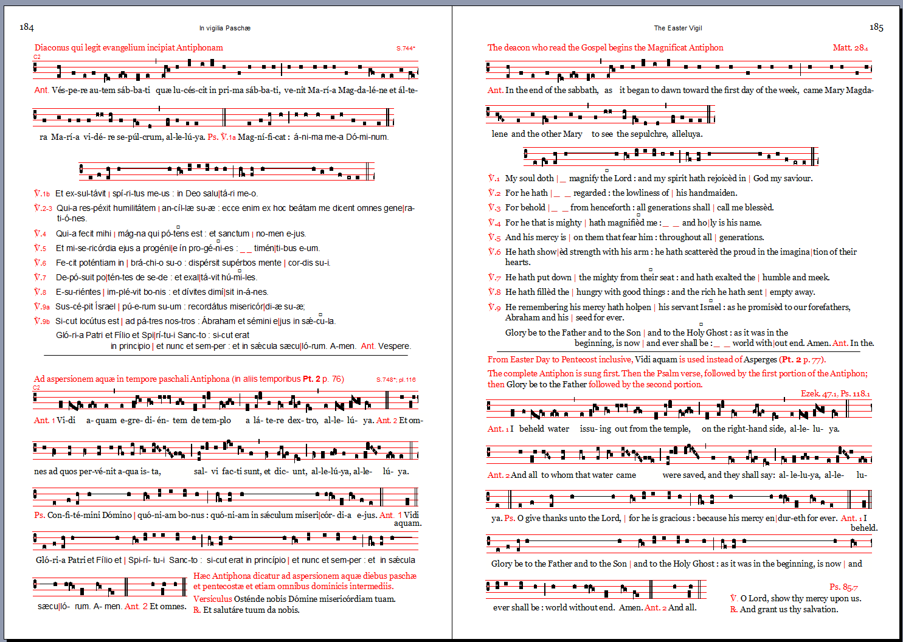
- The first half of this page contains chiefly the words of the Magnificat. The manuscript assumes singers know these by heart so does not bother to give them.It indicates them solely by the brief word Magnif. just above the rubric stating Ad aspersionem aque in tempore paschali.
- The transcription, here and throughout, fills in all the gaps by printing in full the words that are either abbreviated or to be taken as read. The Easter Day Introit Resurrexi begins on the next page, p. 185.
- The English translations are set to the identical music as the originals.
Some quirks in the York Gradual manuscript
- Michaelmas Day, 29 September, ‘The feast of St Michael the Archangel’, gets referred to on other pages as the feast ‘of the angels’, missa de angelis. This is definitely not the mass setting known nowadays as Missa de Angelis, since that came later, and the name has puzzled experts. The solution to the mystery is now revealed.
- The ‘green’ Sundays throughtout summer are called ‘Sundays after Trinity’ in the Sarum Use, from which the term passed into The Book of Common Prayer (1549, 1662). But the Use of York keeps the more widespread western name ‘Sundays after the Octave of Pentecost’.
- The ‘Introit’ chant is, unusually, never called that in the manuscript. Rather it is known as Ad missam officium, the Office at Mass. The chant is a psalm (reduced to just the first verse) with an elaborate antiphon sung before and after and with ‘Glory be to the Father…’. The ‘daily office’ of Mattins, Lauds and Vespers consists mainly of psalms sung like this; hence the manuscript’s name for the Introit chant.
- Twice there are scrawled in the margins some alternative music which is polyphonic. Polyphony is music sung by several voices each singing different but harmonising music. It had started to be developed a couple of centuries before the date of this manuscript but was seemingly frowned upon for liturgical music, only gradually becoming popular in the Renaissance. The manuscript contains only unison plainchant. But otherwise unknown 3-part settings are scribbled, first of Deo gracias, ‘Thanks be to God’ – the response to the dismissal Ite missa est at the end of the service, ‘Go out on your mission’. This response is the reason the entire service is called ‘the mass’.
- The other piece of polyphony is a three-part setting of the hymn tune Veni Creator Spiritus has been roughly scrawled. It has seemingly never been published or performed since the manuscript went out of use in 1550.
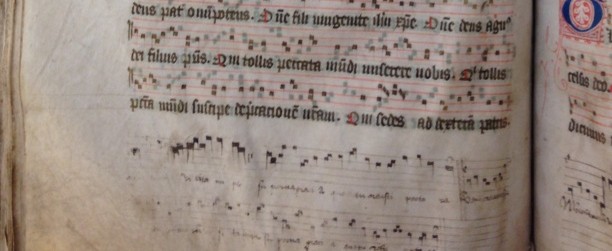
The scribbles at the foot of these facing pages are the 3-part setting of Veni Creator Spiritus.